

Definition of Artist Management
Artist management is the activity and function that seeks to develop the artist’s professional career positively by influencing what the artist does and with whom.
The above is Supervizion’s definition of artist management that we have formulated based on our collaboration with artist managers since the 1980s. This definition captures the meaning of artist management.
Supervizion has business management experience that has accumulated over more than 35 years, in which we have collaborated with artist managers. Drawing on this, we have authored this article with answers to questions on artist management and related topics. Artist management and what artist managers do are explained in depth in this article.
What Does Artist Management Consist of?
Artist management is about creating deals with other industry actors, a sort of active selling of the artist. One example is to attain a record contract for the artist with a record company. Some artist managers also develop formal plans for the artist’s future, while other artist managers take one day at a time.
Artist management is a group of services that include the following:
- Creating deals for the artist
- Artistic and creative development, also called artistic management
- Marketing and public relations (PR)
- Fan relationship management
The person at the artist management company who is the lead person for the services for a specific artist is often called “artist manager”. The artist manager can be assisted by other people that are part of the artist management, but who are not carrying the ultimate responsibility. They might be called assistants or junior managers. Since there is an abundance of tasks to conduct, trainees and interns are often welcome at artist management firms. Some advertise the internships on a regular basis.
How Can an Artist Get an Artist Manager?
Many musicians wish to have an artist manager who works for them and their success. This is how it might sound: ”If we only had artist management, then we would get our breakthrough. We are so good, the only thing missing is an artist manager who gets us connected.”
A fundamental thing to understand is this: Seen from the perspective of the artist manager, there is an important limitation and that is the artist manager’s own time. An artist manager needs to put lots of time on an artist, to make things happen. This means that the artist manager can only have a few artists that they represent, sometimes only a single artist, at least if they are working actively and intensively. The artist manager must be sure that the artists they work with also will bring in money for them, too.
What you can do to get on the radar of an artist manager is to network at industry events and conferences, ask for referrals from other artists, and be visible on social media. If you do it with grace, you can also initiate direct contact such as sending an email. In this case, it is advised to be concrete with what you have achieved and what you are looking for in being represented by an artist manager.
How Much Does an Artist Manager Cost?
An artist manager gets commission on what the artist brings in. An often-seen number is that 15-20 % of what the artist gets as revenue is forwarded to the artist manager as remuneration. This has a consequence. It means that to have a full-time artist manager, you as an artist need to have revenue that is five times or more of what a pre-tax salary at a reasonable market rate is. On top of that there is also a need to be able to cover the indirect expenses of the artist management through the commission, such as their office rent. It is not unusual for the artist manager to collaborate with several artists in parallel to make sure the volume of business is large enough, but it might also be because the artists are at different phases of their career.
An advantage for the artist with this percentage type of payment of the artist manager is that there is usually no need to pay for the work before the results of what the artist manager does has materialized. Even if 20 % serves as a rule of thumb for the artist manager’s cut, there are also splits that reach 50 %. This could actually be justified and fair under some circumstances. If an artist gets 50 % of a really large sum of revenue, it could be greater than 80 % of a small sum. The collaboration with an artist manager could in some cases lead to dramatically larger revenue, but this is hard to predict.
Why is it Difficult to Get Artist Management Representation?
The financial requirement on the artist to already have a certain level of revenue could make attaining artist management difficult. It creates a kind of catch 22: Artists who wish to succeed want an artist manager. But, the artist manager wants artists who have already achieved success.
How Can You Get Artist Management as a Less Established Artist?
Three solutions for the artist could be:
- Do the selling and organizing of the career yourself and grow through your own effort to a basic level to be ready for professional artist management.
- Let somebody close help out to reach the basic level by acting as “artist manager” as part-time work, for example a parent, sibling or good friend. Remember to choose someone who could do it at least equally well as you could yourself. This alternative could otherwise be looked upon as unprofessional and not taken seriously. There are examples of artists who have reached the very top in the world in their genre through this path.
- Choose an artist manager who already works full time with artist management, but who is relatively new in the profession and on the way to get established. Grow together, as an artist and as an artist manager. The artist managers with the most experience and qualified artist managers of today have once been beginners at what they do. Here it is most important that the aspiring artist manager shows good character and suitable personal traits. This as the artist manager’s connections and experience are not yet fully developed. Read more about this below.
How Can You Become a Good Artist Manager?
To be a good artist manager, there are several activities that are central to artist management that need to be mastered. In addition, the personality and psychological traits of the artist manager also matter. A suitable education would increase the chance of becoming a good artist manager.
What Artist Management Activities Are Performed by Artist Managers?
A person who seeks to be a good artist manager needs some personal traits that are suitable for the profession. There are many activities that are central for artist managers and where skill is required. An artist manager does the following:
- Selling and influencing others personally
- Advertising and other forms of marketing
- Communication through media (PR)
- Solving conflicts and differences
- Negotiation and reaching agreements
- Handle participation in projects and make appointments
- Make others become involved and contribute with their efforts
- Initiate and keep personal relationships
- Combine and prioritize elements that business partners contribute with
- Schedule activities in a plan
- Maintain an overview
What are Good Personal Traits of an Artist Manager?
Drawing on the artist management activities that artist managers perform, there are four personal traits of artist managers that are especially fruitful:
- A good artist manager can convince others to cooperate by proving that there is substance in the artistic qualities.
- A good artist manager can make people continue to cooperate by being reliable in relationships.
- A good artist manager possesses sound judgment and knows when to say “no” and when to say “yes” to various engagements.
- A good artist manager does not give up prematurely and has stamina in the efforts to develop the artist’s career, before as well as after a first level of success.
What are the Artist Management Duties?
Artist management has moral and legal duties towards the artist. Most importantly, the artist manager should act in the best interests of the artist. For example, when the artist manager negotiates a deal for the artist with a record company, it is the artist that should be prioritized. What is best for the artist should guide the terms of the contract, not what is best for the artist management firm or artist manager.
Artist management and artist managers also have a duty to accurately and timely account for and distribute the money owed to the artist.
Once the money owed is transferred and the artist has control of the funds, the duty of the artist management ends with regards to this particular money. This is typically the handover point when the business manager takes over, who then assists the artist from there on with the handling of the money. Some artists have an expectation of the artist manager to manage the money in the artist’s possession, but as mentioned, this is outside the duty of the artist management.
Consult a lawyer if you are an artist who is facing a situation that makes you concerned about the relationship with your artist management. The line between immoral but legal behavior of artist managers, compared with illegal behavior depends on several factors. Both civil law and criminal law might be applicable. Seeking professional legal advice can help clarify the situation and does not necessarily result in a lawsuit or other legal action. To be fruitful, artist management is a long-term relationship for an artist and ending it prematurely could jeopardize potential benefits.
What to Consider for Artist Management Contracts?
The artist management contract that the artist signs with an artist manager is one of the most important legal agreements that should be evaluated by a lawyer representing the artist. This is beneficial to both parties and can avoid future trouble. This is because the fairness of the terms gets in balance and the understanding of what to expect becomes more accurate. In this way the artist avoids getting disappointed in the artist manager simply because of a misunderstanding or wrong expectations, and vice versa.
To preempt the risk of getting into an artist versus artist manager conflict, make sure that you understand the text and terms of contracts before you are signing. Be aware that some words in the contract might have other meanings than you expect. Legal language is filled with words with distinct meanings that can be quite different from everyday language. It is also a good idea for an artist to get the advice of an artist business manager on the contract terms. Even without any suspicion of misplaced loyalty of the artist manager, talking to the business manager is a sound thing to do and could enhance the financial gains through the artist management contract.
What Education and Training is Suitable for Artist Management?
The education the artist manager has use for is of course related to the activities mentioned above. An artist management training program would benefit from having business and financial content to get an overview and law to understand contracts. Within business, it is particularly interesting with knowledge about marketing that includes the sub-areas advertising, public relations (PR) and personal selling. An education program to become an artist manager could be a general business program or a industry profession targeted program. Regardless of which, it is also called for to understand the industry where the artist manager will work, such as the music industry. Knowledge about quantitative analysis has increased in value for artist managers.
How Can You Get the Right Artist Manager to Work With?
An artist about to choose an artist manager to work with should consider that being skillful in conducting the activities of the profession (see above) is what matters. Such skill could have its source in formal education, but experience and personal aptitude are also important underpinnings. To exemplify: The artist manager is a sort of salesperson. A good salesperson has knowledge about efficient sales methods (which could be learnt from studies in marketing), can do the work in practice (has attained experience), has stamina (a personal trait).
Beside of a skillful artist manager in general, it is important with a reasonable fit between the artist and the artist manager.
What Questions Should You Ask an Artist Manager You Consider Working with?
As an artist, you could ask a potential manager questions to get an impression of the personal fit between you two:
- Who do you think are my best fans? Where is “my” audience?
- What could we accomplish in a year together?
- How long will I last as an artist?
- What other artists have you worked with?
When you hear the answers, let it bring the discussion into further depth.
When Should You Not Get an Artist Manager?
Question yourself! You should reconsider if you really should have an artist manager if:
- You know that you are a person with a need to always stay in control and find it difficult to let others do things on your behalf. It makes you uncomfortable, regardless of whether it makes sense objectively speaking or not.
- You do things according to you your own personal “recipes”, without discussing things with others. You act on an impulse. You think that you “know best” anyway and therefore there is no need to talk to anyone.
- You find it hard to have patience when others do not carry things out in the manner you think they should. You have difficulties to accept when others do not do things “perfectly” or make mistakes. This while at the same time, you expect others to have patience with your own flaws.
It is important to remember that having a manager is a sort of partnership as well as a personal relationship. You need trust in the manager as a person and the manager’s professional conduct. To discuss and reason around various things with the manager should feel like a natural thing to do.
What is the Difference Between Artist Manager and Personal Manager?
The term “personal manager” is a wider concept than the term “artist manager”, because the personal manager might not necessarily work for/with an artist. A novelist or media personality might have a personal manager. Thus, an artist manager is a more specific type of personal manager. That is, a personal manager who works with/for an artist could also be called artist manager.
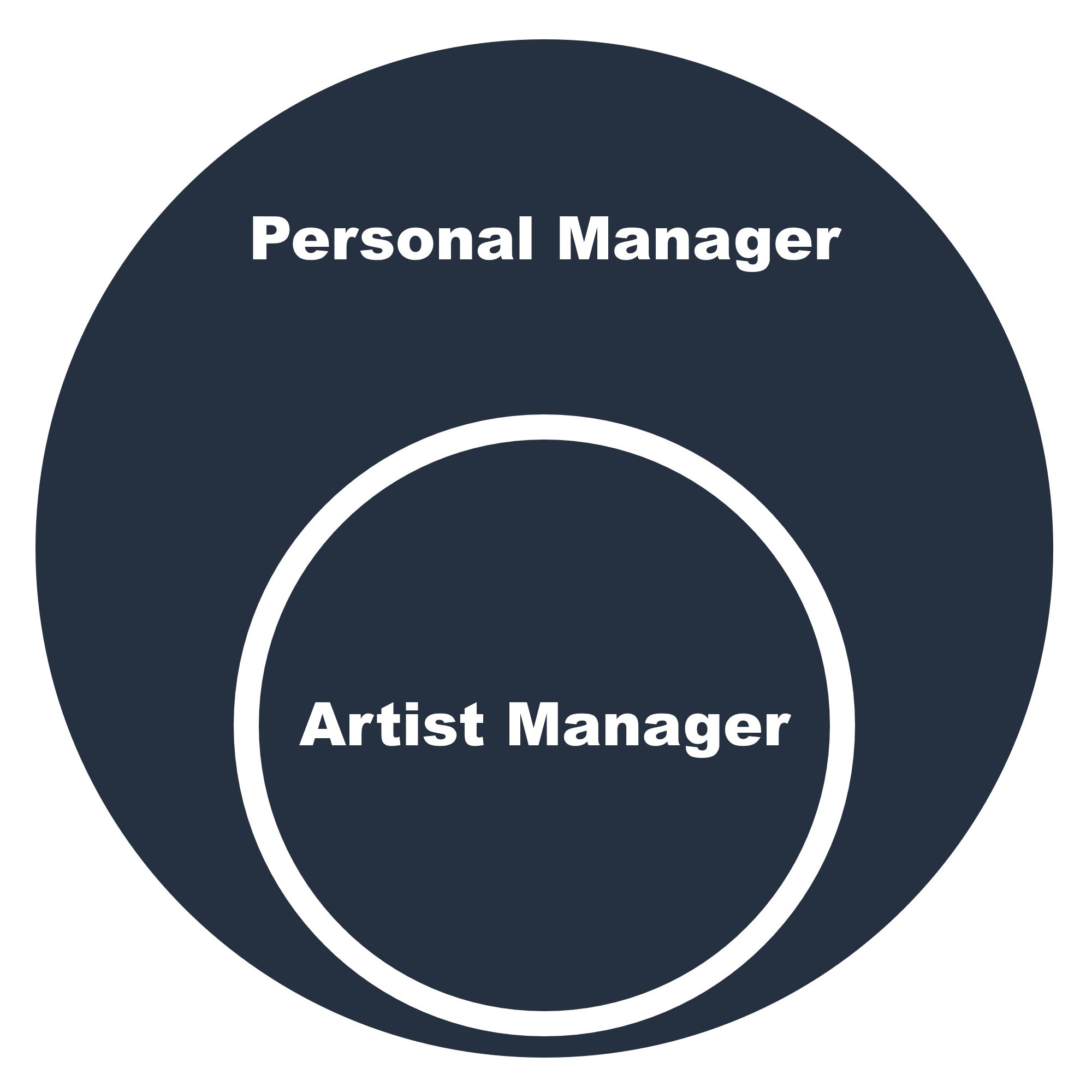
It happens that a music artist begins a career as a singer and later broadens the professional activities to include acting and modelling. This person’s manager would appropriately be called personal manager.
What is the Difference Between Artist Manager and Talent Manager?
An artist manager is sometimes also called “talent manager”. However, we recommend to primarily use the term “artist manager”. Today, it is the more common label. An analysis of a large collection of written material in English comparing the frequency of occurrences of the two professional titles in texts since 1997 showed that “artist manager” is more often used than “talent manager”. This database is available for a fee through University of Pennsylvania if you would like to investigate this further. “Personal manager” is preferred over “talent manager” for managers that enhance the career of other types of creative talents than artists.
Furthermore, “talent manager” has a second valid meaning that is outside of the music industry and entertainment business. It is therefore not so relevant here. Nevertheless, it is still also a correct work title. Some people in human resource departments in larger corporations have the title “talent manager” and they focus on identifying and developing employees that are promising for a future career in the company with ever increasing responsibilities. A different sort of talent manager in the HR department of corporations is someone who manages the talent pool, which is a collection of job seekers that potentially might be recruited for employment in the future. Talent management performed in corporations’ HR departments confuses how people understand “Talent Manager” and what it means in the entertainment industry.
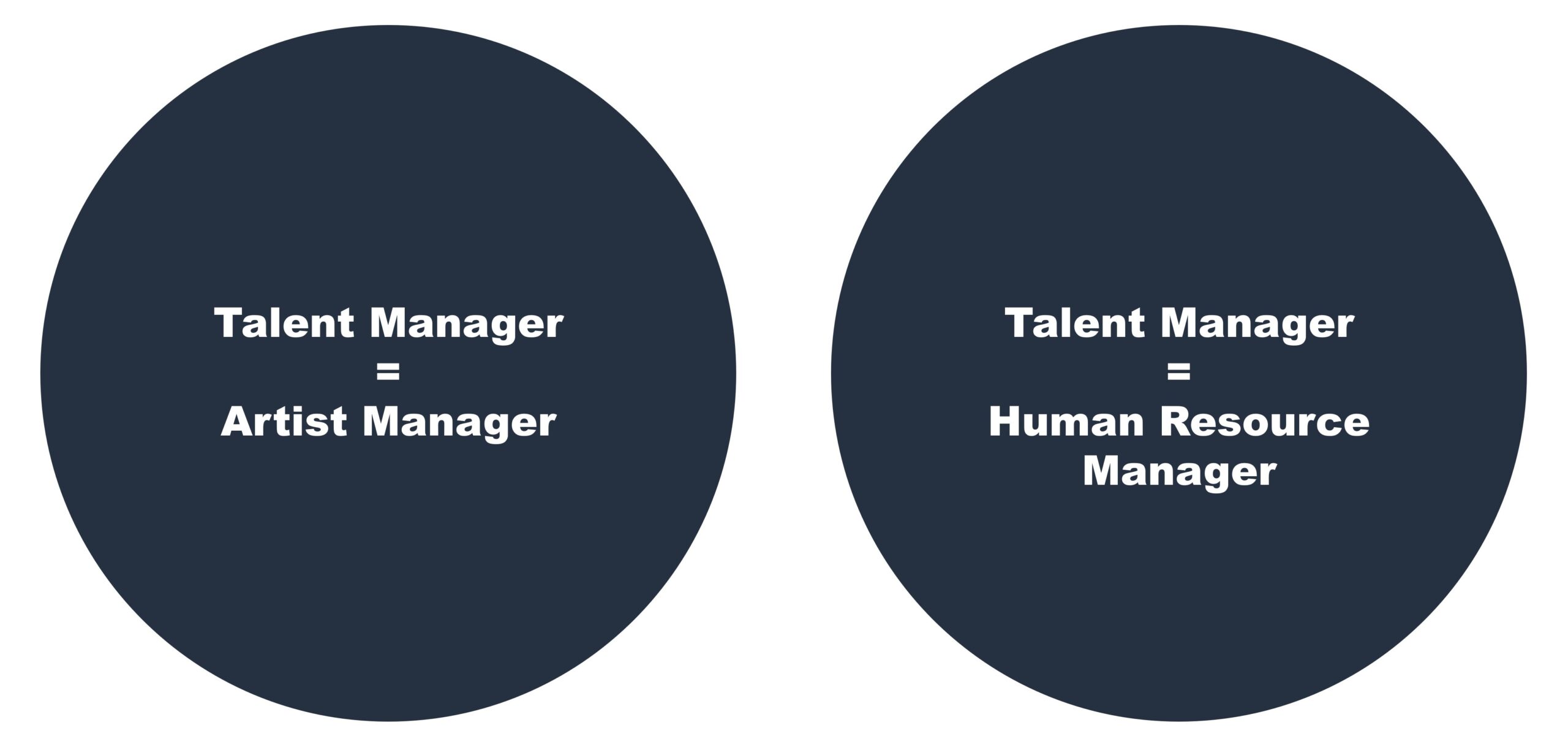
To conclude, if you say or write “artist manager”, more people will understand what you mean (because it is the most used term) and you will also lower the risk of misunderstandings (because you avoid the dual meanings of “talent manager”).
What is the Difference Between Artist Manager and Music Manager?
The difference between artist manager and music manager is slightly more complicated. There are two different things to consider regarding similarities and differences.
A Music Manager as a More Specific “Artist Manager”
A “music manager” could be an artist manager who has delimited the work to only encompass music artists and not other types of artists. This difference is not always paid attention to, because many spontaneously think of music artist, when ”artist” is mentioned.
Artist management for the music business has a dominant focus on vocalists, that is singers and rappers. These vocalists are lifted to celebrity status by successful the artist management work of the artist manager. Music bands are also a significant focus when artist management is done in the music industry. However, musicians who are instrumentalists are less often supported by an artist management team or individual artist manager. So, the “artist” in artist management tends to be vocalists or bands.
Still, this does not exclude the “artist” in artist management from being other forms of artists. Many might think about music artists when someone says “artist”, even if there are other types of artists, too. “Artist” could be understood as a person who exercises “the arts”. A person who creates paintings is also an artist, for example. But often it is a reference to a person performing on stage or presenting the art some other way, such as a dancer or musician.
Several Types of Managers in the Music Industry
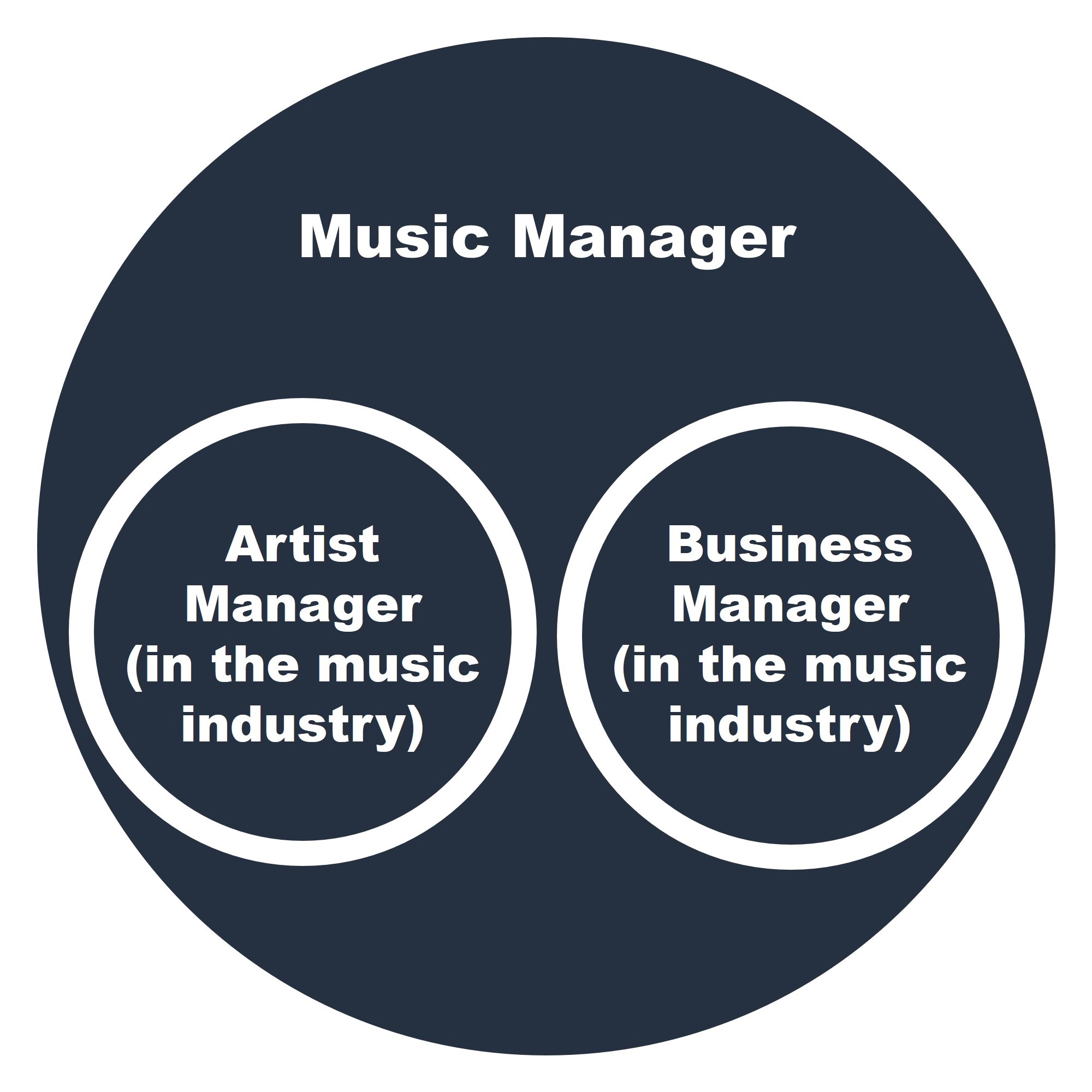
While a music manager could be an artist manager focusing on the music industry, this is not the only type of manager that is included in the label “music manager”. There are other manager types that work with music artists and bands, these are collectively as a group sometimes referred to as “music managers”. Primarily, the term includes those working with the artist as artist manager (personal manager) and business manager. A business manager specializes in money matters.
What is the Difference Between Artist Manager and Agent?
An artist manager sometimes also does the type of things an agent does. What is an agent? Generally, agents are intermediaries that connect those who want to sell and those who want to buy. An agent contacts concert promoters (buyers) and organizes the deal with the artist (seller) of the concert performance. Such agents are more specifically called artist booking agents and work at a type of company called booking agency or artist agency.
In some countries, the artist manager could act as an artist agent also. In other places, it is not even permitted by law to do that. Even when it is allowed to do the booking in-house, the artist manager often collaborates with a booking agent to attain gigs and put together concert tours anyway. Each profession has its focus.
In the fashion modelling industry, it happens that companies label themselves as “model management”, when they actually perform the function of agents. That is, they book the work assignments for the model, but not much more. At the same time, there are companies that describe themselves as model management and in practice really do work more in line with what is generally equivalent of the term personal management (cf. artist management).
Supervizion
Supervizion is a business consulting group. We have provided advice and consulting services since the 1980s. A main field is artist business management, through which we offer various services. We help artists, bands, musicians, music producers, songwriters and other talents with accounting, bookkeeping, business advice and tax management etc. These services are offered under the registered trademark Supervizion Management.
Artist Business Management
Learn more about the difference between artist management and artist business management in this explanatory article on what artist business management is.
